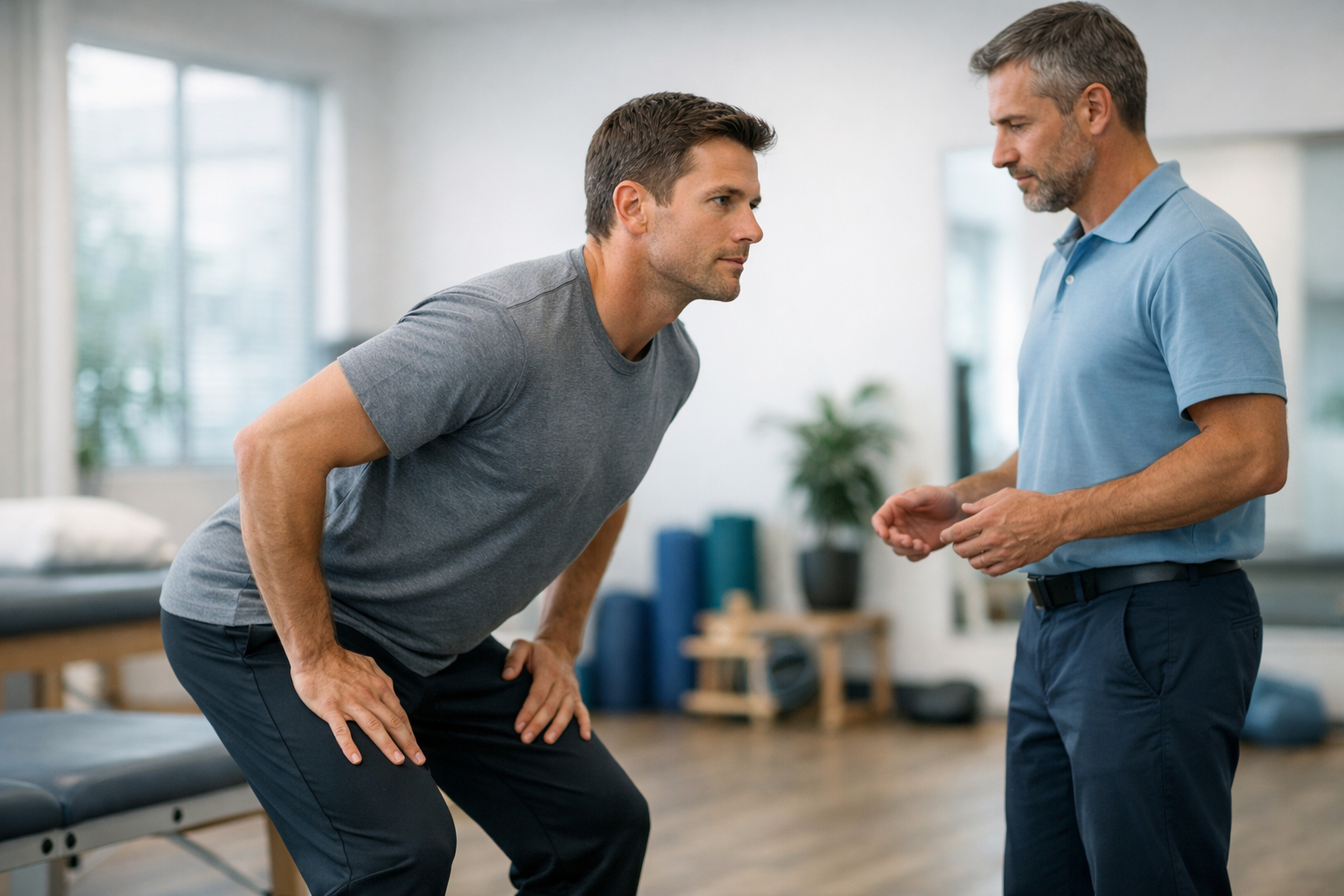
If you are experiencing changes in sexual performance, your first thought is unlikely to be your back, hips or posture.
Most men look at hormones. Stress. Age. Or assume it is something they just have to accept.
But there is a recurring pattern we see.
Men with:
- Tight hips
- Lower back discomfort
- Poor posture
- Weak or overactive core muscles
Also tend to experience changes in sexual function.
At first, this connection can seem unexpected.
But once you understand how the body works as a system, it becomes very clear.
WHY SEXUAL FUNCTION IS NOT JUST ABOUT ONE AREA
Your body does not separate movement from function.
Everything is connected.
Your pelvic floor sits at the centre of a wider system that includes:
- Your hips
- Your lower back
- Your abdominal wall
- Your breathing
If one part of that system is not working well, another part compensates.
And more often than not, the pelvic floor takes on that extra load.
THE ROLE OF YOUR HIPS
Your hips are designed to move freely.
They should allow:
- Rotation
- Flexion and extension
- Stability during movement
But modern lifestyles change this.
Long hours sitting, limited mobility at work, and repetitive patterns can lead to tightness.
When the hips lose mobility:
- The pelvis becomes restricted
- Movement patterns change
- The pelvic floor starts to compensate
This can increase tension and reduce coordination.
Which then feeds directly into sexual performance.
HOW YOUR LOWER BACK PLAYS A ROLE
The lower back and pelvis are closely linked.
If your lower back is:
- Stiff
- Overworked
- Frequently uncomfortable
Your body will often stabilise by increasing tension in surrounding muscles.
Including the pelvic floor.
This creates a situation where:
- Movement becomes less efficient
- Muscles stay switched on for longer than they should
- Relaxation becomes difficult
Over time, this can affect blood flow, control and overall function.
THE CORE IS NOT JUST ABOUT STRENGTH
When most people think about the core, they think about strength.
But the core is really about coordination.
It needs to:
- Engage when required
- Relax when required
- Work with your breathing
If the core is overactive, which is common in men who brace or hold tension, it creates downward pressure on the pelvis.
This increases pelvic floor tension.
If it is underactive, the pelvic floor may try to compensate.
Either way, balance is lost.
POSTURE AND DAILY HABITS
This is where things become very practical.
How you sit, stand and move throughout the day has a direct impact on your body.
For example:
- Sitting for long periods shortens the hip flexors
- Slouching affects breathing patterns
- Bracing your abdomen increases internal pressure
Over time, these patterns become automatic.
You are not thinking about them.
But your body is constantly adapting to them.
WHY THIS AFFECTS ERECTIONS AND PERFORMANCE
When the system is not working efficiently, several things happen:
- Blood flow can become less effective
- Muscle coordination is reduced
- The nervous system becomes more reactive
- Tension becomes the default state
This can show up as:
- Inconsistent erections
- Reduced control
- A feeling of tightness or restriction
- Difficulty relaxing during intimacy
Again, this is not just about one muscle.
It is about how the system is functioning as a whole.
A SIMPLE EXAMPLE
Think about someone who spends most of their day sitting.
Their hips become tight.
Their lower back stiffens.
Their breathing becomes shallow.
Their core becomes overactive.
Their pelvic floor follows that pattern.
Now add stress on top of that.
It becomes very easy to see how symptoms begin to develop.
WHAT ACTUALLY NEEDS TO CHANGE
The goal is not to isolate one area and try to fix it.
It is to restore balance across the system.
1. Improve Movement in the Hips and Spine
This allows the pelvis to move more freely.
Reducing the need for compensation.
2. Restore Proper Breathing
Breathing has a direct effect on the pelvic floor.
Better breathing leads to better control and relaxation.
3. Reduce Unnecessary Tension
This includes:
- Over-bracing
- Clenching
- Holding tension throughout the day
Small changes here can have a big impact.
4. Build Coordinated Strength
Not just stronger muscles, but muscles that work together properly.
This is what improves long-term function.
WHAT WE SEE IN PRACTICE
Many men come in focused purely on sexual symptoms.
They are not thinking about their hips, back or posture.
But once we assess movement and tension patterns, the link becomes clear.
When these areas improve, sexual function often improves alongside them.
Not because we treated the symptom directly.
But because we addressed the system.
REASSURANCE FOR YOU
If you have noticed changes in your body over time, whether that is stiffness, discomfort or reduced performance, it does not mean something is “broken”.
It often means your body has adapted to how you are using it.
And with the right approach, those patterns can change.
This is not about chasing perfection.
It is about restoring function in a way that feels natural again.
FINAL THOUGHT
If you are unsure whether your posture, movement or physical health is affecting your sexual performance, the next step is to get a clear understanding of how your body is functioning.
A confidential assessment allows us to:
- Identify movement restrictions and compensation patterns
- Understand how your pelvic floor is behaving within the system
- Give you a structured plan tailored to your body
No guesswork. Just clarity and a clear path forward.
NEXT STEP
If you want to understand how your body contributes to your symptoms and what you can do about them, you can begin with a confidential consultation.